
Why NASA Is Letting a 3,200-Pound Telescope Burn Tonight
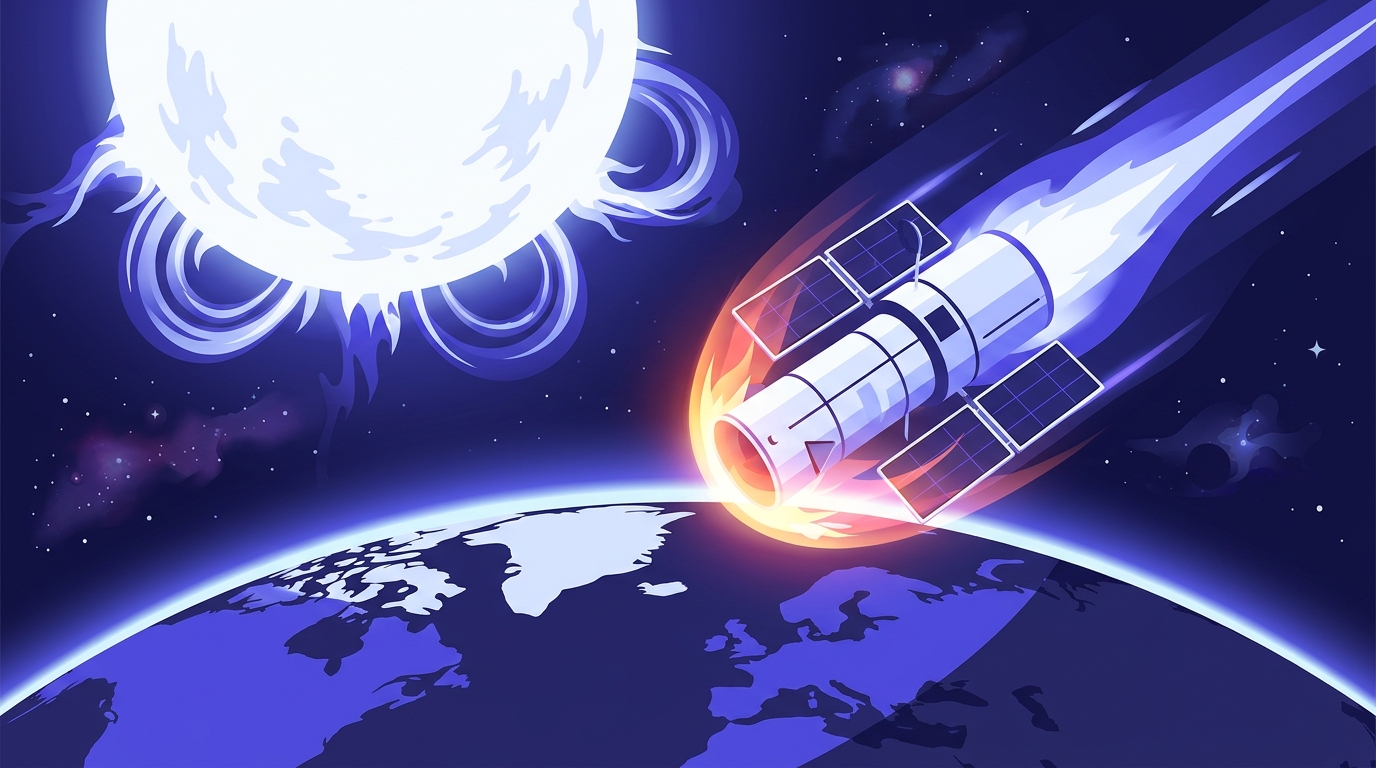
Right now, somewhere high above our heads, a 3,200-pound robotic sentinel is plunging toward Earth at twenty-two times the speed of sound. It has no fuel left. It has no thrusters to push itself back into the safe vacuum of high orbit. Within hours, atmospheric friction will rip off its solar arrays, melt its aluminum chassis in a 3,000-degree fireball, and scatter whatever survives across a remote stretch of open water.
That dying spacecraft is NASA's Neil Gehrels Swift Observatory.
For twenty-two years, Swift served as humanity's planetary perimeter alarm. Whenever a massive star collapsed into a black hole halfway across the observable universe, Swift caught the invisible gamma-ray flash within seconds, slewed its mirrors autonomously, and alerted ground-based observatories across Chile, Hawaii, and South Africa before the explosion could vanish. It cracked open the mystery of cosmic violent bursts.
Now, it's crashing.
I've tracked orbital decay events for over a decade, and there's something uniquely heartbreaking about watching a legendary space telescope die like this. It didn't break down. Its instruments were still capturing high-energy photons right up until the final commands were sent. What killed Swift wasn't mechanical failure or a broken computer. It was the Sun, bad timing, and a glaring blind spot in modern space logistics.
Here's why Swift is burning tonight, why a last-minute commercial rescue mission collapsed behind closed doors, and what this disaster tells us about the ticking time bomb threatening the rest of our flagship space telescopes.
The Invisible Culprit: How Solar Cycle 25 Sealed Swift’s Fate
If you ask most people what brings down a satellite, they'll tell you gravity. That's only half the truth. Gravity keeps the spacecraft in orbit; atmospheric drag is what drags it down. And right now, Earth's upper atmosphere is puffing up like a heated balloon.
Our planet's thermosphere doesn't have a rigid ceiling. It thins out gradually over hundreds of miles. At 600 kilometers up—where Swift spent most of its productive life—the atmosphere is so sparse that human lungs couldn't grab a single breath. But it isn't an absolute void. A faint whisper of atomic oxygen and nitrogen lingers up there. Over decades, those rogue particles smack into solar panels and structural trusses, bleeding off orbital momentum millimeter by millimeter.
Under normal conditions, that decay takes forty to fifty years. But the past two years haven't been normal.
We are living through the explosive maximum of Solar Cycle 25. The Sun's magnetic pole cycle has unleashed relentless coronal mass ejections, giant sunspot groups, and violent blasts of extreme ultraviolet radiation. When that radiation slams into Earth's upper atmosphere, it superheats the thermosphere. Heated gases expand outward into space. Suddenly, satellites orbiting at 400 to 500 kilometers aren't flying through a near-vacuum anymore—they're plowing through a wall of gas ten times denser than standard mission models predicted.
Swift was exceptionally vulnerable. When NASA launched it from Cape Canaveral aboard a Boeing Delta II rocket on November 20, 2004, engineers designed it for split-second agility, not orbital endurance. To whip around the sky in under sixty seconds to lock onto short-lived gamma-ray bursts, Swift needed minimal mass and zero sloshing propellant. So engineers made a fateful design choice: they didn't include an onboard propulsion system.
Zero thrusters. No hydrazine. No electric propulsion.
Swift relied entirely on reaction wheels and magnetic torquers to spin itself around. That setup worked brilliantly for pointing at distant cosmic explosions. But against an expanding thermosphere? It was completely helpless. Once Swift's altitude dropped below 300 kilometers earlier this year, the physics turned relentless. Atmospheric drag scales exponentially as altitude drops. Over the last forty-eight hours, Swift began dropping miles of altitude on every single trip around the globe. The spiral became impossible to break.
The Rescue Scramble: Why Commercial Tugs Couldn't Save It
The obvious question you're probably asking right now is straightforward: why didn't we just fly up and push it higher?
We have the technology. We live in an era where commercial rockets launch every few days, private space firms routinely dock capsules to the International Space Station, and companies like Astroscale and Starfish Space are openly marketing commercial orbital tugs designed to grab aging satellites and boost their orbits.
Behind closed doors, those discussions actually happened. Over the past eighteen months, informal proposals floated between commercial servicing firms and NASA's Science Mission Directorate. The operational concept sounded simple enough: launch a small commercial propulsion tug, rendezvous with Swift in low Earth orbit, latch onto its launch adapter ring, and fire thrusters to push its altitude back up to 600 kilometers. That single burn would have bought Swift another twenty years of active astronomy.
So why didn't it happen? Three brutal roadblocks killed the plan.
- No Standardized Docking Interface: Swift was designed in the late 1990s, long before the industry developed universal docking standards. It has no magnetic grapple plates, no optical fiducials for autonomous lidar navigation, and no robotic latch points. Grappling a tumbling 3,200-pound cylinder with fragile solar panels without accidentally smashing it requires expensive, custom-built robotic hardware.
- The Budget Meat-Grinder: NASA's science division is facing historic budget squeezes. Between the skyrocketing price tag of the Mars Sample Return program and broad federal spending caps, astrophysics funding has been slashed. An emergency commercial servicing contract would have cost between $80 million and $130 million. Agency managers faced a cold calculation: spend nine figures on an unproven rescue attempt for an aging 2004 observatory, or let it burn to preserve funding for upcoming flagships like the Nancy Grace Roman Space Telescope. Bureaucratic math won out.
- Development Lead Time vs. Solar Reality: Building, testing, and qualifying an autonomous robotic grappling spacecraft takes eighteen to twenty-four months under the best conditions. Solar Cycle 25 didn't give NASA that luxury. The extreme solar flare activity of 2024 and 2025 accelerated Swift's orbital decay timeline by nearly four years. By the time serious funding talks started, the spacecraft had already slipped below safe rendezvous altitudes. The window slammed shut.
Running this independent global desk on Dev Dominion gives me the freedom to call these institutional blunders what they actually are without filtering the truth through agency press releases. NASA leadership knew Solar Cycle 25 was coming. They knew Swift had no propulsion. Yet officials hesitated until the atmosphere made the choice for them.
What Actually Survives a 3,000-Degree Reentry?
Let's clear up a persistent myth: spacecraft don't simply vanish into harmless fairy dust the moment they touch the upper atmosphere.
Swift's plunge is an uncontrolled reentry. Because the observatory lacks thrusters, flight controllers at NASA's Goddard Space Flight Center in Greenbelt, Maryland cannot aim the vehicle into Point Nemo—the oceanic spacecraft graveyard in the South Pacific where decommissioned satellites are deliberately plunged. Swift will hit wherever orbital decay forces it down.
Here is what happens during tonight's final descent:
Around 80 kilometers (50 miles) above the planet, the incoming air resistance forms an intense hypersonic shock wave in front of the spacecraft. Temperatures surrounding the hull quickly shoot past 3,000 degrees Fahrenheit (1,650 degrees Celsius). The thin solar arrays will break away first, shredding and burning within seconds.
Between 75 and 65 kilometers, structural disintegration takes over. The main aluminum frame will soften, melt, and tear apart into a blinding trail of white-hot plasma visible across hundreds of miles if it passes through a night sky. Most of the internal electronics, data cables, and thin instrument enclosures will disintegrate entirely.
However, Swift isn't made purely of light aluminum. It carries dense, heat-resistant components. The primary X-ray telescope mirrors, the beryllium optical mounts, and heavy titanium structural fittings have melting points that survive standard atmospheric friction. NASA's Orbital Debris Program Office estimates that between 10% and 40% of a satellite's dry mass typically survives atmospheric reentry and hits the surface.
That means between 320 and 1,200 pounds of scorched metallic debris will hit the ground or ocean at terminal velocity—roughly 200 to 280 miles per hour.
Should you grab a helmet? Statistically, no. Earth's surface is 71% water, and huge portions of the remaining landmass are unpopulated deserts, forests, and plains. NASA calculates the human casualty risk for uncontrolled reentries at roughly 1 in 10,000, which meets accepted international safety limits. The US Space Force's 18th Space Defense Squadron is tracking the spacecraft's radar footprint pass by pass. But low probability isn't zero probability.
The Hubble Warning: The Clock Is Ticking for Our Greatest Flagship
If you think Swift's death is an isolated anomaly, you haven't been paying attention to what's happening to the Hubble Space Telescope.
Hubble is the undisputed crown jewel of space astronomy. But just like Swift, Hubble is trapped in low Earth orbit. It currently sits at an altitude of approximately 515 kilometers—and it's dropping every day. Atmospheric drag pulls Hubble downward with every orbit. Because the Space Shuttle fleet was retired in 2011, astronauts can no longer ride up in Atlantis, grab Hubble with a mechanical arm, and boost it back to a safe altitude.
NASA knows this crisis is looming. That's why the agency quietly issued a formal Request for Information to private aerospace companies, seeking commercial ideas to reboost Hubble's orbit before 2030. Jared Isaacman and the Polaris Dawn team even ran initial feasibility studies with SpaceX to examine whether a modified Crew Dragon spacecraft could dock with Hubble and push it higher.
Swift's fiery demise tonight is the ultimate warning sign. It proves that atmospheric drag doesn't pause for committee meetings. If NASA and private industry don't finalize a commercial reboost mission for Hubble within the next few years, Hubble will face the exact same fate: an uncontrolled, flaming death plunge through the atmosphere.
We are living in an era of reusable super-heavy rockets, yet we are still treating our most valuable scientific instruments like disposable relics. That contradiction needs to end.
Twenty-Two Years of Catching Cosmic Monsters
Before Swift burns into an ash cloud tonight, we need to remember what this extraordinary piece of engineering gave us. When Swift launched in 2004, astrophysicists were locked in a mystery regarding gamma-ray bursts—immense flashes of energetic radiation that burst randomly across deep space, outshining billions of stars for a few seconds before disappearing forever.
Before Swift arrived, by the time astronomers received a ground alert and manually slewed a ground telescope, the burst had already vanished. The explosion was long gone.
Swift changed the entire game. It carried three synchronized instruments: the Burst Alert Telescope (BAT), the X-ray Telescope (XRT), and the Ultraviolet/Optical Telescope (UVOT). The second BAT detected a gamma-ray flicker anywhere in its wide field of view, the spacecraft didn't wait for human controllers. Its autonomous guidance computer calculated the coordinates and spun the entire satellite around in twenty to seventy seconds flat, pointing its high-resolution X-ray and optical mirrors at the dying spark while it was still searing hot.
Over its two-decade run, Swift delivered astonishing breakthroughs:
- Proving How Black Holes Are Born: Swift confirmed that long-duration gamma-ray bursts mark the violent core collapse of massive stars into infant black holes.
- Pinpointing Kilonova Explosions: In 2017, when gravitational wave detectors sensed two colliding neutron stars, Swift was among the first instruments to track the resulting kilonova—verifying where heavy elements like gold and platinum are created across the universe.
- Watching Stars Get Eaten: Swift observed tidal disruption events in real time, recording the radiation signatures of stars being shredded and devoured by supermassive black holes at the hearts of distant galaxies.
- Cataloging Over 1,500 Bursts: It created a public database of high-energy cosmic transients that researchers will analyze for decades to come.
That is an incredible return on investment for a spacecraft originally funded for a two-year mission.
My Verdict: We Need an Orbital Tow Truck Fleet
Watching Swift plunge into the atmosphere tonight feels like watching an irreplaceable national laboratory burn down because nobody wanted to fund the local fire department.
I don't buy the argument that saving Swift was technologically out of reach. The capability exists right now. What failed was institutional will and an agreed-upon framework for orbital logistics. We are launching thousands of satellites every year into low Earth orbit, yet we have failed to build a basic municipal service fleet for orbital towing, refueling, and life extension.
Every scientific satellite launched from this day forward should carry two mandatory features: standardized mechanical grappling rings for commercial tugs, and cooperative transponders for active deorbit maneuvering.
Tonight, as Swift's telemetry flatlines and its metal frame lights up the upper atmosphere, remember the lesson it leaves behind. The universe is packed with wonders, but low Earth orbit is ruthless. If we don't build the infrastructure to service and protect our sentinels in space, gravity and the Sun will keep dragging our eyes back down to Earth.